
A packed meeting calendar does not mean you have to quit training. Three full-body sessions of about 45 minutes each are enough to maintain and build strength for busy people if you pick the right six moves and cap rest times. This article gives an alternating A/B pair on Mon–Wed–Fri, rules for missed days, and how to keep week three from becoming the week you quit.
Upside of 3-day full-body: each major muscle group gets hit often, and every session still “counts” even if next week you only protect those three slots.
45-minute session structure
- Warm-up: 5 minutes (joint circles + 1 very light set of the main lifts).
- Main block: 6 moves, 2–3 sets.
- Rest between compound sets: 90 seconds (start a timer; do not lose 3 minutes to your phone).
- Isolation rest: 60 seconds.
- Cool-down: 2–3 minutes of breathing and a short stretch.
When you are ready for a fourth day, ease into the 4-day upper–lower muscle-building plan.
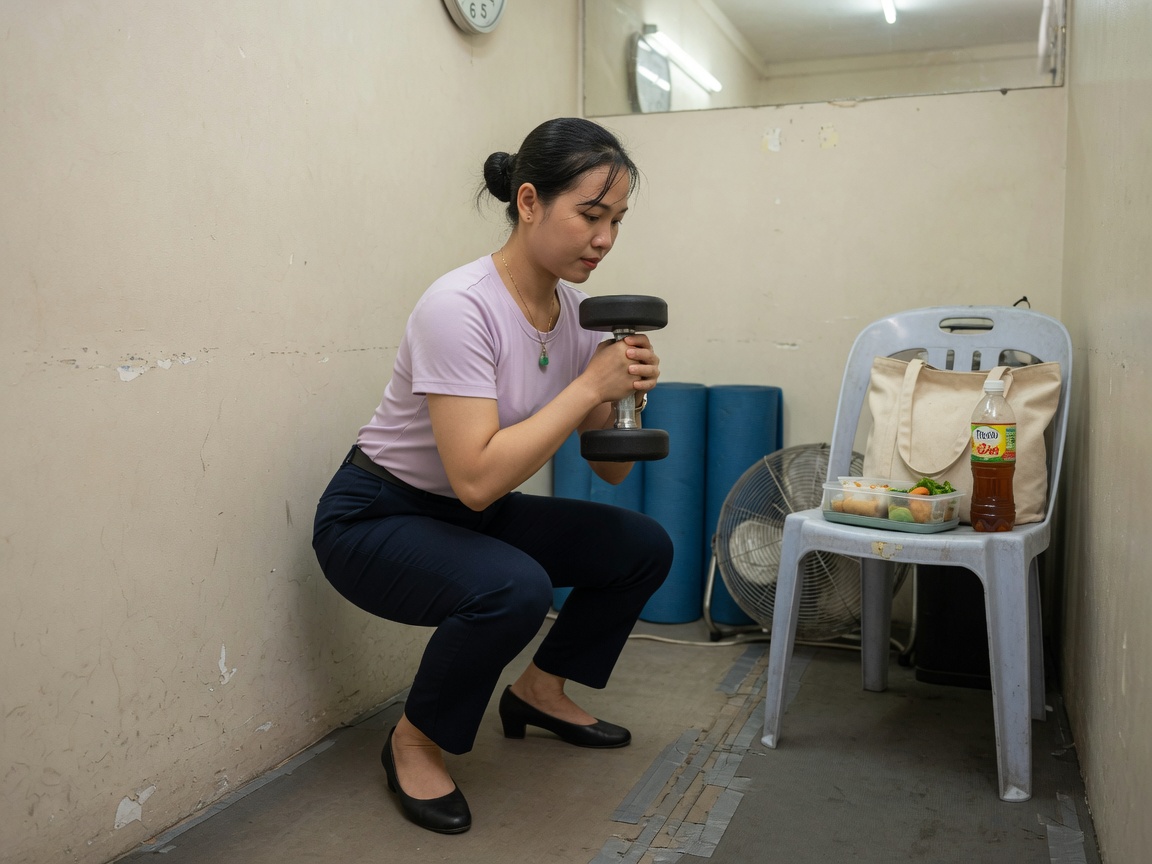
Session A and session B
Session A (e.g. Monday and alternating)
- Goblet squat or barbell squat: 3×6–10
- Bench press: 3×6–10
- Horizontal row: 3×6–10
- Romanian deadlift: 2–3×8–10
- Light–moderate overhead press: 2×8–10
- Dead bug or plank: 2 sets
Session B (e.g. Wednesday)
- Split squat or leg press: 3×8–10 per side
- Incline press or machine press: 3×8–10
- Pulldown / assisted pull-up: 3×8–12
- Hip thrust or loaded bridge: 3×8–12
- Band face pull or light reverse fly: 2×12–15
- Side plank: 2×20–30 seconds per side
Friday rotates: even weeks do A, odd weeks do B (or the reverse). Keep a load log so next week you know when to add +1–2 reps or +2.5 kg with clean form.
Move order is intentional so big patterns still have gas: heavy legs or press first, pull right after pressing for balance, hinge and shoulder/core stability in the back half. If the gym is crowded, you can swap bench and row as long as you do not park a heavy RDL between two high-balance moves when you are already tired.
Choose loads so the last set still has about 1–3 clean reps left. Beginners often progress fastest by learning technique; do not add plates just because the person next to you is heavier. A “good enough” session finishes all six moves with the timed rests — not an 80-minute session stretched by phone scrolling.
Sample week
| Day | Session | Duration | If something comes up |
|---|---|---|---|
| Monday | Full-body A | ~45 minutes | Prioritize the first 4 moves |
| Tuesday | Walk | 20–40 minutes | No need for hard effort |
| Wednesday | Full-body B | ~45 minutes | Keep the 90-second rests |
| Thursday | Walk / rest | — | Sleep early if you are short on sleep |
| Friday | Full-body A or B | ~45 minutes | Can trim to 35 minutes |
| Weekend | Rest | — | Do not “punish” with long HIIT |
Rules when you miss a day
- Miss one session: shift it one day if that keeps ≥48 hours before the next heavy similar load; otherwise skip and do the next planned session — never stack two sessions in one day.
- Only 25 minutes left: first 4 moves, 2 sets, 75-second rests.
- Miss a whole week: next week return at 5–10% below the prior week’s loads, prioritize form, do not “repay volume debt.”
- Travel: swap for a 20–30 minute bodyweight circuit (chair squat, leveled push-up, hinge, plank).
A week that finishes 2 of 3 sessions still beats 0 of 3. Protect the streak of “showing up,” then optimize set count.
Do not quit in week 3
Week 1 is excitement, week 2 is sore, week 3 is meeting pile-up — the common break point. Prepare ahead:
- Pick a non-negotiable time slot (e.g. 6:30 a.m. or right after work).
- Pack training clothes / water the night before.
- Make the weekly goal three sessions present, not PRs.
- More habit strategy in don’t quit in week 3.
Progress over 6–8 weeks
Keep the same A/B pair. When you hit the top of the rep range with clean form, add a small load or one rep. Do not swap all six moves every week — change a variation only for pain or missing equipment.
Log example: week 1 goblet squat 16 kg × 3×8; weeks 2–3 climb to 3×10; week 4 to 18 kg × 3×7–8 then climb again. Same pattern for bench and row. If a week has poor sleep or travel, keep the load and focus on form instead of forcing numbers.
Sleep and protein still decide how the next session feels. Busy people often cut sleep to “get more done”; treat 7 hours as part of the training plan. Peri-workout meals only need familiar carbs and protein — no elaborate ritual.
Minimum gear and quick swaps
- Dumbbells + bench: run A/B as written.
- Machines only: swap squat for leg press, row for seated row, keep one single-leg move.
- Hotel: chair squat, leveled push-up, backpack hinge, backpack row, plank — still counts if you do a structured 20–25 minutes.
FAQ
Is 3-day full-body worse than a 5–6 day split?
For busy people and beginners through intermediates, three quality sessions usually beat six abandoned ones. When time and recovery allow, you can raise frequency later.
Do I need separate cardio?
Walking on off days covers base health. If fat loss is the goal, raise steps to 7–10k rather than adding two exhausting runs on an already full calendar.
Can A and B be only one day apart?
Mon–Wed–Fri is the sweet spacing. Mon–Tue–Thu still works if you ease heavy RDLs or drop isolation sets on the second consecutive day.
This is general schedule guidance, not medical advice. If you have a chronic condition, acute pain, or are rehabbing an injury, get professional clearance before applying these loads.