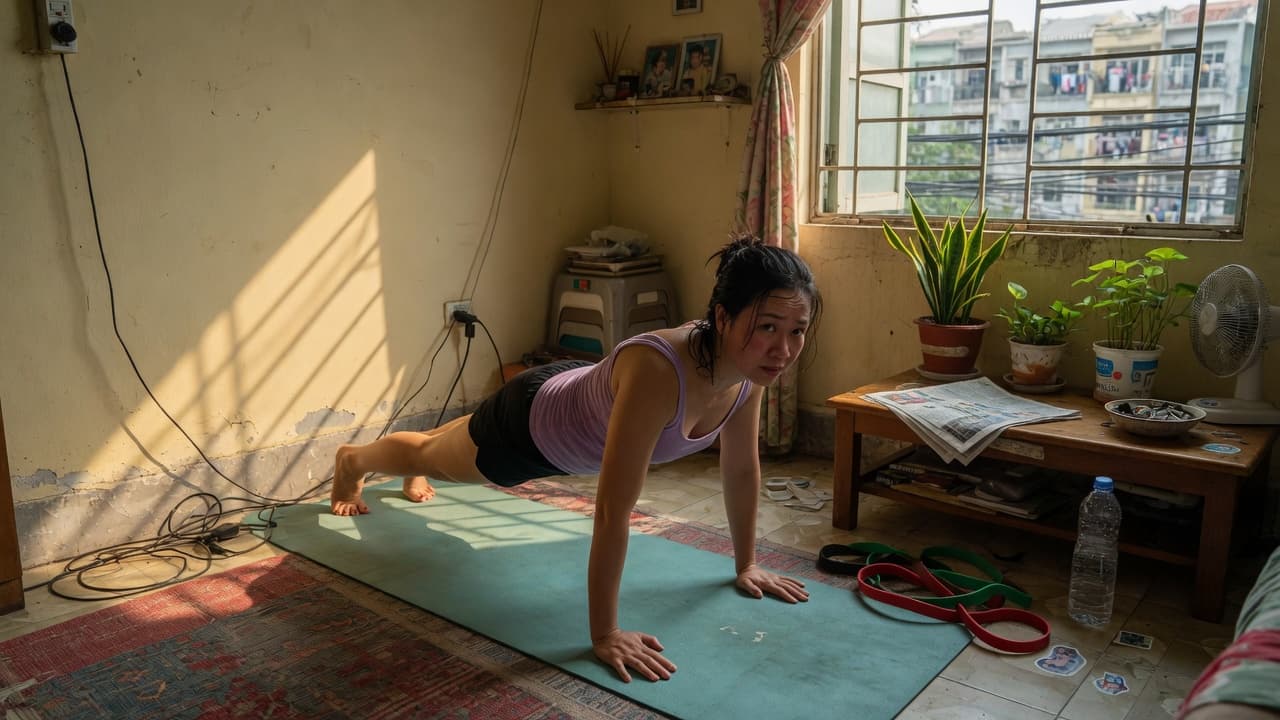
No machines, no big room: a living-room corner is enough for a 30-minute full-body session with bodyweight and (optional) a resistance band. This article gives a 3-round circuit, clear work–rest times, 3-day and 5-day weekly versions, and tips so you do not crash into furniture in a tight space.
The goal is not “maximum sweat at any cost.” It is enough stimulus for legs–push–pull–core in half an hour, repeatable for many weeks.
Rules for a 30-minute session
- 3 rounds of the same circuit.
- Each move: 30–40 seconds of work or a fixed rep count; rest 20–30 seconds before the next move.
- Rest between rounds: 90–120 seconds.
- 3-minute warm-up: joint circles, unloaded squat, short plank.
- 2-minute finish: slow breathing, light hamstring and chest stretch.
If push-ups are still new, use the wall → incline → knees progression in push-ups in 5 stages instead of forcing ugly form.
Standard 3-round circuit (no machines)
- Chair / shallow box squat: 10–15 reps — sit with control to the chair, then stand; do not dump the hips.
- Push-up at your level: 6–12 reps — wall, table, knees, or full.
- Clean hip hinge (unloaded good morning or RDL with water bottles): 10–12 reps — hips back, long spine.
- Band or towel row (isometric pull): 10–12 per side or 12–15 with both hands — squeeze shoulder blades back and down.
- Split squat in place: 8–10 per leg — hold a chair if balance fails.
- Dead bug or high plank: 8 per side or 20–30 seconds — ribs down, no over-arching the low back.
Those six moves make one round. Do all three. Total time is usually 26–32 minutes depending on rests.
Tight room: face feet parallel to the mat edge, push the sofa back 50 cm, and use in-place split squats instead of long walking lunges.
Optional band variations
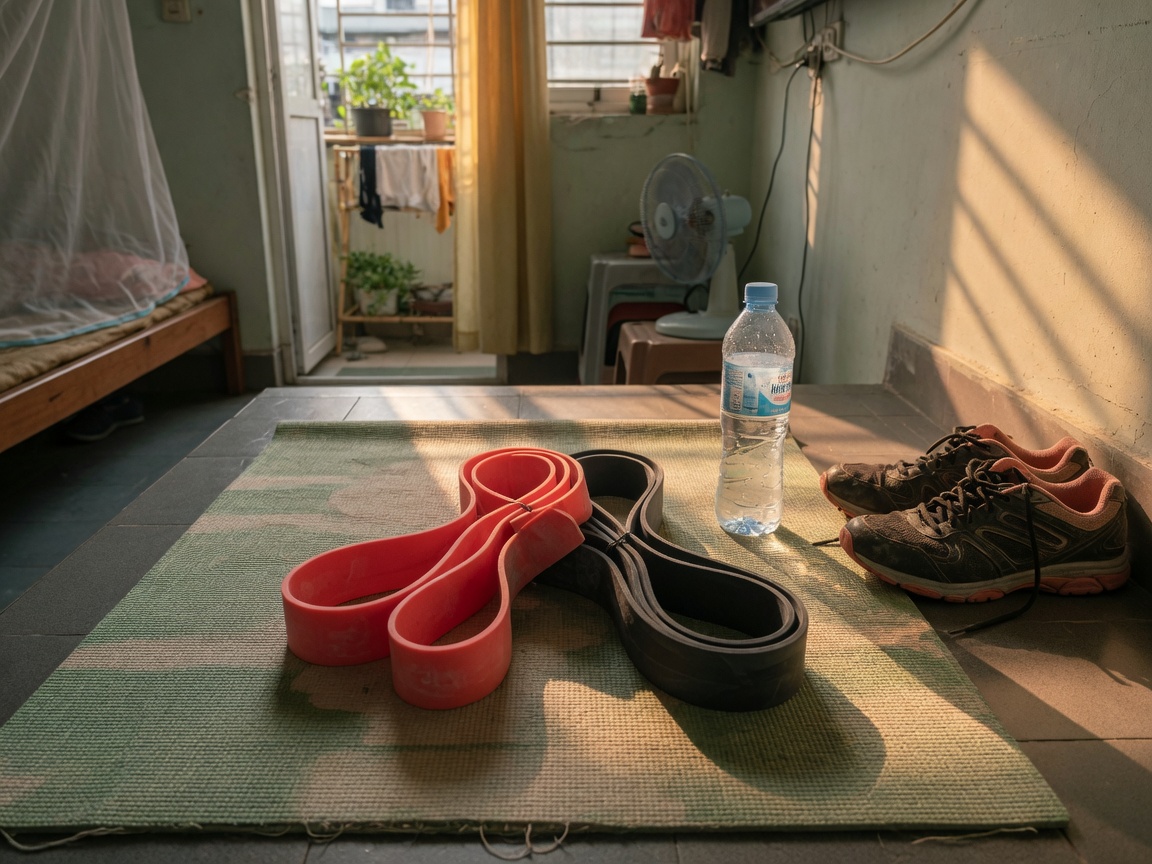
If you have a band:
- Swap the towel row for a standing or seated band row.
- Add band pull-aparts 12–15 after round 2 for healthier shoulders.
- Loop a light band above the knees on squats to cue knees not collapsing inward.
No band still works: slow the lowering phase (3 seconds down), pause 1 second at the bottom, or add a fourth round when three become easy.
3-day and 5-day schedules
| Version | Training days | How to use the circuit | Best when |
|---|---|---|---|
| 3 days/week | Mon–Wed–Fri | Full 3 rounds | Beginners, packed meeting weeks |
| 5 days/week | Mon through Fri | Odd days 3 rounds; even days 2 rounds or drop the split squat | You want a daily habit with lower per-session load |
Off days: walk 20–30 minutes. When you are ready for a gym frame with weights, ease into the 3-day full-body 45-minute plan.
How to progress after 2–3 weeks
- Raise work time from 30 to 40 seconds; keep rest at 20 seconds.
- Move push-ups up one stage when you can do 3×12 clean.
- Add a 2-second pause at the bottom of squats and split squats.
- Good morning → assisted single-leg RDL holding a chair (small range).
- High plank → slow shoulder taps once the core is solid.
Sharp joint pain, dizziness, or chest pain means stop. Muscle soreness for 24–48 hours can be normal; sharp joint-edge pain is not “one more set.”
Real living-room constraints
- Low ceiling / ceiling fan: skip jumps; use squats and in-place steps.
- Neighbors below: drop burpees and jumping jacks; choose soft steps and planks.
- Kids / pets: block off the mat area; favor standing moves with a chair for support.
- Slippery floor: wear shoes or use a non-slip mat; no long lunges.
Common mistakes
- Rushing, using momentum, forgetting to breathe.
- Only picking “sweaty” moves (jumps) and skipping pulls and hinges.
- Resting 2–3 minutes between moves so the session balloons to 50 minutes — then quitting.
- Training five days like competition days — at home, consistency beats “breaking records.”
FAQ
Can 30 minutes at home build muscle?
For beginners and returners, yes — especially legs, shoulders, and core. When three rounds feel too easy even after progressing difficulty, add load (dumbbells, a backpack of books, a heavier band) or a longer session.
Do I need separate ab work?
Dead bugs and planks in the circuit already hit the core. If you want five more minutes, do side planks after the last round instead of hundreds of fast crunches.
Morning or evening — which is better?
The slot you can keep at least three times a week is the good one. Avoid a huge meal right before a circuit with deep hinges and squats.
This is general at-home training guidance, not a medical exam or prescription. Stop and seek professional help if unusual pain, lasting dizziness, or medical symptoms appear.