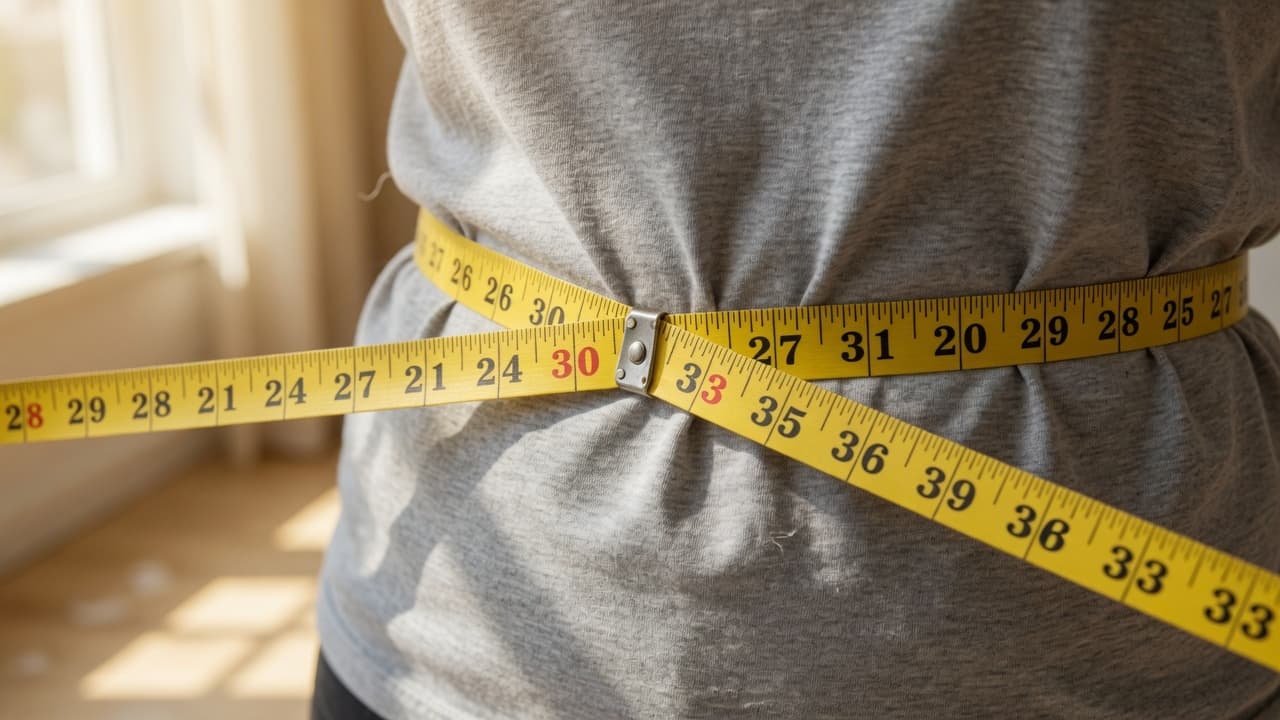
Waist measurement helps see trunk/belly-fat trends when the scale is noisy from the cycle and water — but only if you measure at the same landmark, same morning, same tape tension, and avoid big conclusions on period days. 4-week frame: use averages or a few clean landmarks, pair with photos, do not obsess over 0.1 cm error. This is tracking mindset, not abdominal disease diagnosis.
Multi-signal tracking: progress tracking for women beyond the scale. Period week: eating during your period without wrecking the plan. Keep momentum: do not quit in week 3.

Why measure waist instead of only weight?
- Weight jumps with sodium, glycogen, menstruation, temporary constipation.
- Waist (and photos) sometimes shrink while weight stalls — recomposition.
- Conversely, the waist feels fuller on period weeks even when fat did not rise equivalently in a few days.
One measurement while bloated after a team-building lunch is not a “failed month.”
Unified measuring protocol
- Morning, after the bathroom, before a large meal/drink (or the same routine you pick and keep forever).
- Stand tall, breathe normally; measure at the same landmark (e.g. across the navel, or the narrowest point — pick one and note it).
- Tape flat, parallel to the floor, not cinched into a skin groove.
- Record rounded to 0.5 cm; measure twice, average if they differ.
- Also note: period week? poor sleep? salty day before?
| Week | Do | Avoid |
|---|---|---|
| Week 1 | 1–2 clean measures; baseline photos | Measuring 5×/day comparing every mm |
| Week 2 | Remeasure same protocol; note cycle | Changing the landmark for a “prettier” number |
| Week 3 | Measure; if it lands on the period, note but do not conclude | Harsh calorie cuts from period numbers |
| Week 4 | Compare to week 1 (prefer non-period days) | Obsessing over 0.1–0.5 cm within error |
Period days and water retention
Before and early in the period, many people feel a fuller waist–belly. Mark it in the log: that number is for feel context, not alone to change eating–training strategy. Comparing mid-cycle week to last month’s mid-cycle week is usually fairer.
- Do not cinch the tape harder to “still get the old number.”
- Do not skip measuring all month — only skip hard conclusions on the 2–3 fullest days.
- Photos in the same cycle phase when possible.
Reading a 4-week trend
A slow drop of a few cm over 4 weeks with looser pants is a good signal for many people in a moderate deficit. Flat numbers but rising strength and cleaner photos can still be progress. Clear rise plus eating far over frame and little movement: review adherence before blaming “broken metabolism.”
- Average of 2–4 clean measures in the month > one outlier.
- Pair weekly average weight + squat/pull logs.
- Only make large plan changes when 3–4 weeks of signals align and eating–training have been fairly solid.
Mindset: do not obsess over 0.1 cm
- Tape error, posture, and breath easily shift ~0.5–1 cm.
- Daily measuring easily becomes an anxiety ritual — 1–2×/week is enough for most.
- Eating-disorder history: consider dropping the tape if it triggers; use strength and energy with a professional.
FAQ
1. Which cycle day is the “most correct” waist measure?
There is no magic day. What matters is repeating the same conditions and comparing similar-phase weeks. Do not anchor decisions to the fullest period day.
2. Waist unchanged after 4 weeks?
Check real portions, protein, sleep, and the training log. You may need a mild tweak or more patience if the deficit is shallow. Do not extreme-cut for one measurement.
3. Should I also measure hips–thighs?
Yes if curves are the goal: hip/thigh numbers may stall or rise slightly as muscle grows — not every number must always fall.
Education on waist-tracking habits — not internal medicine exams or eating-disorder counseling. Sudden abdominal circumference change, pain, or measurement anxiety affecting life — talk with a doctor/mental-health professional. The writer is not a physician.