Walking lunges train legs–glutes and expose every balance weak point: knee cave, torso tip, steps so long the hips twist. This article fixes step length, knee–toe direction, how to hold the torso, and in-place variations when the floor is narrow or you are new.
You do not need load to learn form. Add a light goblet only when each step is stable and joints are pain-free.
What one clean step looks like
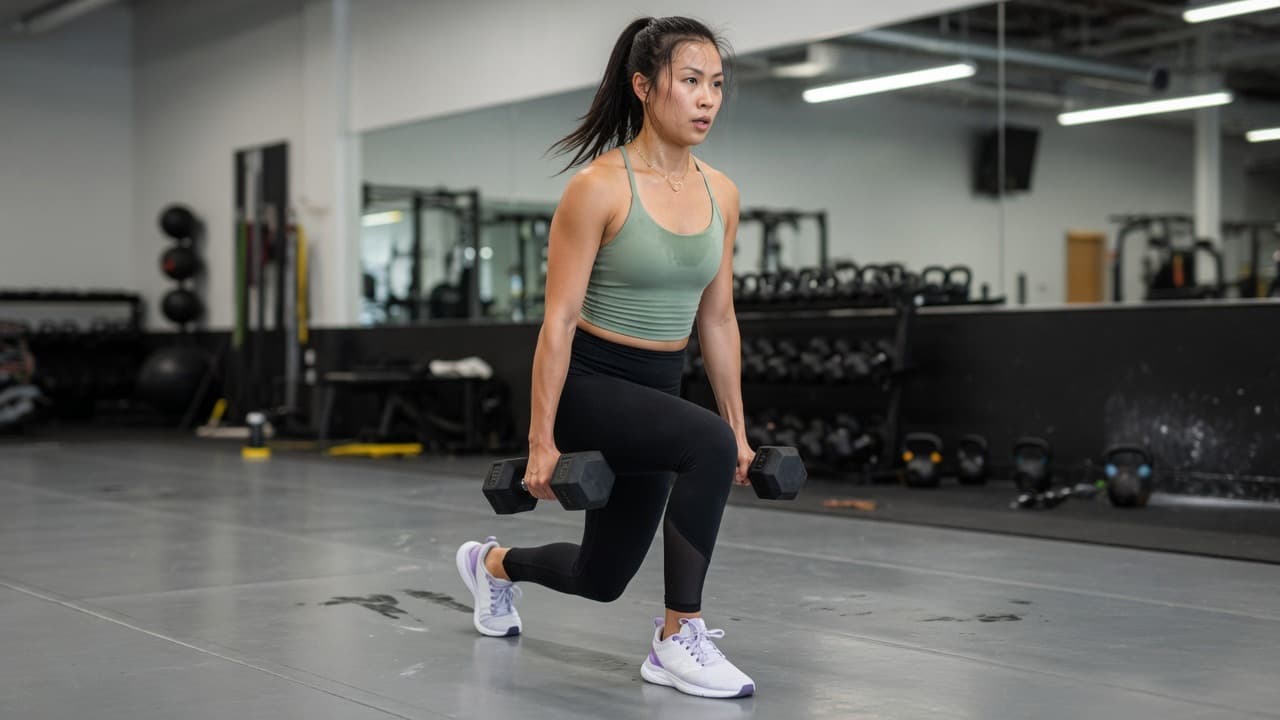
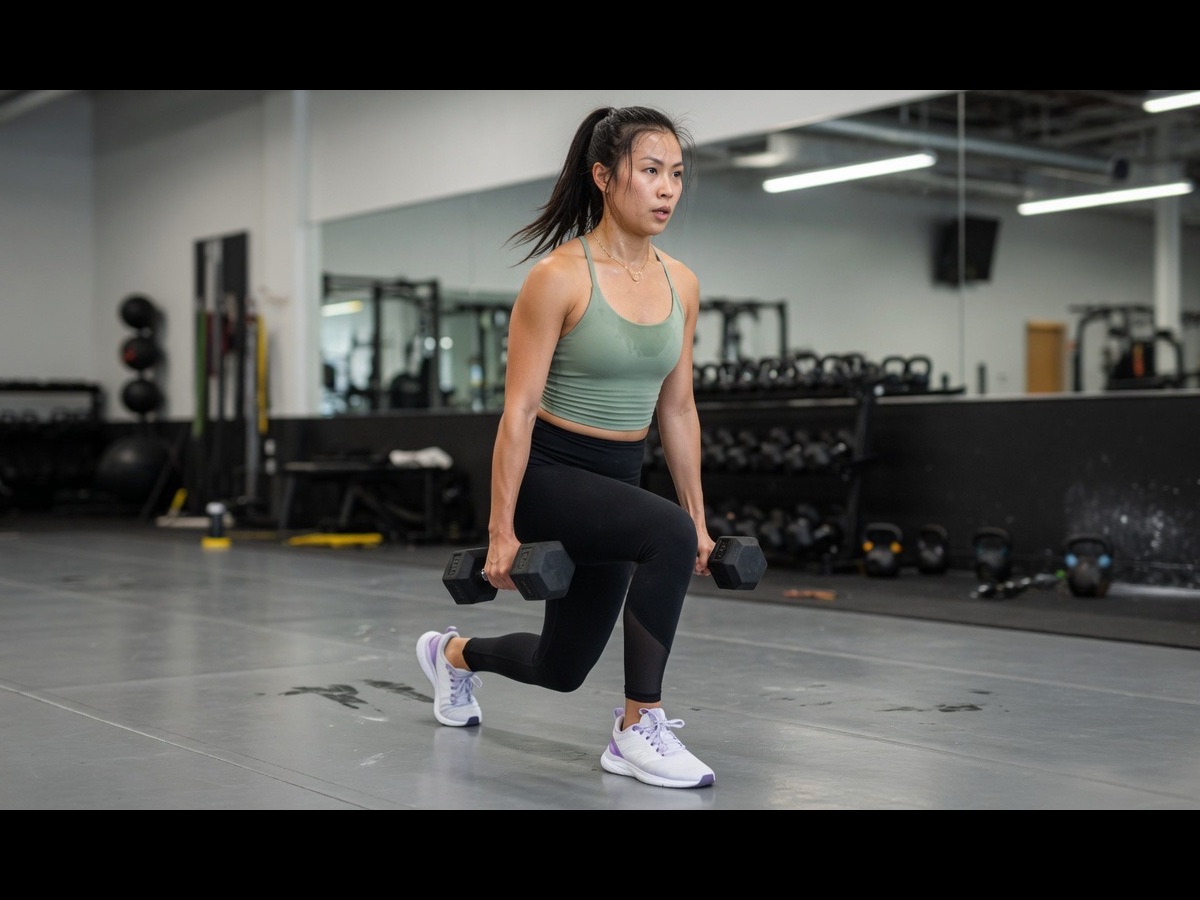
- Step forward far enough that both knees are about 90 degrees at the bottom — not so short it becomes a “bob,” not so long the hips seize and the torso tips.
- Front knee tracks over the toes; it does not cave inward as you drive up.
- Front heel presses the floor; rear knee lowers under control toward the mat (no slamming).
- Torso tall or with a small intentional forward lean; avoid tipping sideways.
- Drive through the front leg into the next step; no hopping.
Drills before you “walk”
- In-place split squat: 2–3×8/leg — learn balance and depth.
- Step-out and return: step forward, lower, drive back to stand — 8/leg.
- Unloaded walking: 2×8–10 steps/leg on an imaginary straight line.
- Only then add a light goblet or two water bottles.
Cue: “step – lower between both feet – tall torso – drive the floor with the front heel – rear leg steps through, no dragging.”
Glutes, quads, and balance
A slightly longer step with a tall torso often emphasizes glutes–hamstrings more; a shorter step with the front knee traveling farther forward can emphasize quads more. Adjust to your goal and knees — there is no one golden ratio for everyone.
| Problem | Sign | Fix |
|---|---|---|
| Knee cave | Front knee collapses inward on the drive | Slow down, cue knee–toes, drop the load |
| Torso tip | Lean toward the front leg | Arms at shoulder height, eyes on a fixed point |
| Step too long | Hips seize, hard to stand up | Shorten the step 10–15 cm |
| Slamming the rear knee | Noise, pain on the rear kneecap | Lower slowly, pad the floor, reduce depth |
Office workers with stiff hip flexors should warm hips–ankles first; see leg training for office workers and 8-minute warmup.
Where it sits in a session
- Leg day: 3×8–12 steps/leg after squats or as an accessory.
- Full-body: 2×8/leg unloaded or light goblet.
- Hotel / tight home: use in-place split squats instead of walking — 30-minute hotel plan.
- 3-second lowers when you want control before early load jumps.
Pair glute bridges or RDLs in the week so the posterior chain gets enough stimulus — glute bridge to hip thrust.
Goblet and tempo once stable
When 2×10 unloaded steps per leg already track straight, hug a light dumbbell at the chest. Load raises core demand and exposes torso lean earlier. Keep elbows tight to the chest; do not let the weight tip you forward. A 3-second lower on the first 1–2 sets helps knees and hips learn braking before you speed the steps.
- First loaded week: 2 light goblet sets + 1 unloaded technique set.
- Do not lengthen the step and add load in the same session.
- Between sets, easy walk 30 seconds instead of folding over gasping and losing the next set’s control.
When to change the variation
- Sharp front-knee pain: shorten the step, reduce depth, switch to reverse lunges (step back).
- Lots of balance loss: light wall touch or stay on split squats.
- Slick floor: good shoes, drop walking, stay in place.
- Fatigued end of session: cut to 2 sets instead of forcing ugly form.
FAQ
Are reverse lunges better than walking?
Reverse is often easier on front-knee control for many people. Walking is handy for travel and volume. Pick what knees and space allow.
Must the rear knee touch the floor?
Not required. Controllable depth with the front thigh near parallel and no pain is enough. A light touch on a mat is fine; slamming the knee is not.
Lunges every day?
High daily volume easily piles up knee–tendon fatigue. 2–3 sessions/week inside a leg or full-body plan is usually more sensible than “lunges daily until wrecked.”
General lunge technique only — not an orthopedic exam. Stop and seek care for unusual knee–hip pain, swelling, or sudden instability.